


Before talk about applications of dispensing robots, let’s discuss glue dispensing.
Sounds simple, right?
Just put the right amount of glue in the right place, and you’re good to go.
But in reality? Traditional manual dispensing is slow, inconsistent, and expensive.
It’s a mess. Imagine an automotive electronics company struggling to meet production targets.
Their workers, as skilled as they are, can only manage 2,000 units a day.
Then, they bring in an I.C.T intelligent dispensing robot—boom!
Production jumps to 8,500 units daily.
That’s over four times the output, with zero extra labor cost.
Now, let’s talk waste. Human hands are amazing, but they’re not precise.
When people dispense glue manually, the amount varies by ±20%—that’s a lot of wasted material!
In contrast, I.C.T’s smart dispensing system controls the flow with ±1% precision.
One PCB company found this out the hard way.
Their poor dispensing accuracy led to over $700,000 in annual rework costs. But after switching to automation?
They cut those losses by 80% in just one year.
That’s real money back in their pocket.
BTW, click here to learn about Troubleshooting and maintenance tips.
| Problem | Manual Dispensing | I.C.T Smart Dispensing |
| Daily Output | 2,000 units | 8,500 units |
| Glue Precision | ±20% error | ±1% error |
| Setup Time | 4-8 hours | 10 minutes |
| Annual Waste Cost | $700,000+ | Reduced by 80% |
The Future of Glue Dispensing: Where the Industry is Headed
The applications of dispensing robots are changing—fast.
And if you’re still doing things the old way, you’re going to get left behind.
The world is moving towards automation, intelligence, and efficiency.
Here’s where the market is headed, and why I.C.T is leading the charge.
1. Governments Are Pushing Smart Manufacturing
In China, the “Made in China 2025” initiative is pumping billions into automation.
The goal? 500 industrial robots per 10,000 workers by 2025.
That’s a massive shift. And guess what?
Glue dispensing robots are a key part of this revolution.
Companies that adopt them now will be miles ahead when automation becomes the industry standard.

2. Technology is Making Robots Smarter
Robots aren’t just fast—they’re getting insanely precise.
With AI-powered vision, they can position glue with an accuracy of ±5μm.
That’s 20 times finer than a human hair.
And thanks to 5G+IoT, companies can adjust settings in real-time from anywhere in the world. Even better?
AI-driven fault detection now predicts failures with over 90% accuracy—meaning less downtime and more profits.

| Tech Breakthrough | Impact on Glue Dispensing |
| AI Vision (±5μm) | Ultra-precise application |
| 5G+IoT | Real-time remote control |
| AI Fault Prediction | 90%+ accuracy, less downtime |
3. More Industries Are Jumping In
It’s not just consumer electronics anymore.
Glue dispensing robots are expanding into semiconductors (growing 25% annually), electric vehicle batteries (demand up 300%), and medical devices (sterile dispensing up 18%).
The industries that require precision and reliability are turning to automation—fast.
4. Sustainability Is No Longer Optional
Companies today can’t afford to waste materials—and the new tech ensures they don’t.
The latest piezoelectric jet valves improve glue utilization to a mind-blowing 98% efficiency.
At the same time, new wastewater and emissions treatment systems are 60% more effective than before.
Less waste, more savings, and a cleaner future.
In-Depth Analysis of Five Core Application

Screen Packaging and Display Module Assembly
Let’s talk about screens—the beautiful displays we all love.
In today’s world, everyone wants sleek devices with ultra-thin bezels.
But achieving that look? It’s not easy.
Traditional glue methods just don’t cut it anymore.
They’re messy and imprecise.
But now, with non-contact piezoelectric jetting technology, we can apply glue as thin as 0.1mm with an accuracy of ±0.02mm.
This means no more damage to those delicate flexible screens, like the ones on foldable phones.
A Success Story
Imagine a leading panel manufacturer struggling with an 87% yield rate.
Not great. But after adopting this advanced technology, their yield skyrocketed to 99.5%.
That’s a massive improvement. And the savings?
A whopping 12 million yuan annually.
Microelectronic Component Precision Dispensing

Let’s dive into the world of microelectronics.
These tiny components are the heart of our modern devices, and placing them accurately is crucial.
Traditional methods? They’re just not cutting it anymore.
But now, with nanometer-level metering pumps, we’re talking about dispensing glue with a resolution of 0.1 nanoliters.
That’s incredibly precise.
This technology is perfect for tasks like bonding LED chips, which require as little as 0.01 milligrams of adhesive, and packaging 5G RF modules.
Industry Data: Speed and Precision
In the fast-paced world of microelectronics, efficiency is key.
With these advanced dispensing systems, we can achieve up to 200,000 dispensing actions per hour.
That’s lightning-fast. And the precision?
An impressive ±5 micrometers.
Plus, the leakage rate is less than 0.01%, ensuring minimal waste and maximum reliability.
Dispensing Robots in PCB Manufacturing
Electronics are everywhere, and Printed Circuit Boards (PCBs) are the backbone of modern devices.
But making them stronger, more reliable, and long-lasting?
That’s where dispensing robots come in.
These machines bring high precision, speed, and efficiency to an industry that’s always looking for better ways to do things.
Let’s break it down in the simplest way possible.

1. Fixing & Strengthening Electronic Components
Keeping Components in Place – No More Loose Parts!
Imagine you’re holding your phone, and one day, after a tiny drop, it stops working.
Why? Because a small capacitor inside came loose.
That’s a nightmare for manufacturers!
I.C.T’s dispensing robots fix this by applying glue right where it’s needed, making sure components stay in place, even in tough conditions.
Perfect for: Electrolytic capacitors, cement resistors, inductors—basically, anything that needs extra strength.
Smart Technology: Using vision positioning (±0.05mm precision), the robots adjust the glue angle automatically, ensuring perfect coverage.
Real Impact: One electronics factory reduced component failure by 90%, saving tons on repairs and replacements.
Surface-Mount Components (SMD) – Tiny But Tough
Small parts like resistors and capacitors can move due to heat or vibrations.
That’s why precision glue application is key.
Super Precise: Piezoelectric jet valves ensure 0.01ml glue accuracy, and the glue dot size is just 0.3mm.
Next-Level Accuracy: 3D vision corrects PCB warping, so every part stays exactly where it should.
Success Story: A car electronics company saw its failure rate drop from 5% to 0.3% after upgrading to I.C.T’s dispensing robots.
2. Protecting PCBs – More Than Just Glue
Coating for Moisture, Dust, and Corrosion Resistance
Think about your smartwatch.
It goes through rain, sweat, maybe even the ocean!
But its circuit board stays safe.
That’s because of a protective coating applied with extreme precision.
Uniform Protection: Non-contact spraying ensures 10-50μm thick coatings, with an error margin of just ±5μm.
Bubble-Free Application: Vacuum-assisted technology reduces trapped air by 90%, making coatings flawless.
Big Wins: A telecom company increased its coating success rate from 85% to 99%, saving £800,000 in rework costs.
BGA Chip Underfill – Strength from Within
Ball Grid Array (BGA) chips are essential, but they come with a problem: tiny gaps that can cause failures if not properly filled.
Super Smart Application: A vacuum system improves flow by 40%, ensuring glue reaches every tiny gap.
Adaptive Tech: The robot adjusts pressure in real time, compensating for glue viscosity changes.
Game-Changer: A semiconductor company cut failure rates from 8% to 0.3% – that’s reliability at its best!
3. Optical & Structural Bonding – The Future of Displays
Mini LED Backlight – Making Screens Shine Brighter

Your TV, your tablet, even billboards—Mini LED technology is making screens brighter, sharper, and more energy-efficient.
But that requires perfectly formed micro-lenses.
Ultra-Precise Dots: Glue dots measure just 0.3-0.5mm, with a height-to-diameter ratio of 0.6-0.8.
Laser Accuracy: A spectral confocal sensor ensures thickness precision of ±1μm.
Clear Results: A display factory saw 85% uniformity jump to 98%, reducing dark spots by 90%.
Conductive Glue for Shielding & Grounding
In high-performance devices, electromagnetic interference (EMI) is a big deal.
Conductive glue provides an efficient solution.
Powerful Pump System: Screw pump dispensers handle high-viscosity glue (100,000 cPs), forming precise 0.1mm-wide glue lines.
4. High-Speed Production – Faster, Smarter, More Flexible
Mass Production for Consumer Electronics
Think of your earbuds, smartwatch, or even your gaming console.
Their PCBs need super thin glue lines, and they need them fast.
| Technology | Improvement |
|---|---|
| Dual-valve system | 300% faster glue application |
| AI-powered setup | Changeover in 10 min instead of 4-8 hours |
| Cycle time | One valve dispenses in 60ms |
- Factory Boost: One manufacturer went from 2,000 to 8,500 units per day, cutting glue waste by 70%.
Camera Module Optical Bonding
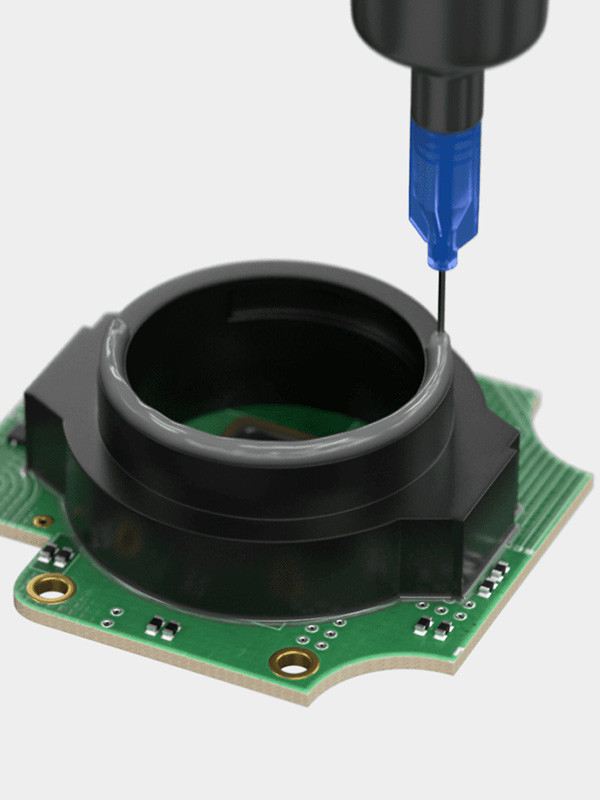
Camera modules are the “eyes” of many modern devices—whether it’s your phone, car, or VR headset.
To ensure top-notch performance, precision is key.
This is where advanced technologies, like 6-axis robots with vision correction, play a crucial role.
These systems can align the lens with incredible accuracy, achieving precision within ±0.01mm—that’s remarkably tight.
On top of that, the adhesive used allows for more than 95% light transmission, which is essential for high-performance optical components like those found in AR/VR lenses.
Semiconductor Packaging & Chip-Level Dispensing

Let’s talk about semiconductors. The backbone of modern tech.
Your phones, computers, cars—they all run on chips.
And when it comes to packaging these tiny but powerful components, precision is everything.
Nano-Level Glue Control
We’re in the era of Wafer-Level Packaging (WLP).
Imagine an 8-inch wafer packed with millions of chips, each needing perfect underfill.
The glue? It’s controlled at the nanoliter level.
That’s unbelievably precise. One tiny mistake?
Boom—whole batch ruined.
That’s why top manufacturers are investing in high-tech dispensing robots to get it right, every time.
The Future of Dispensing Robot: Smarter, Faster, Better
The future is coming fast.
It’s all about automation, AI, and smarter ways of working.
The companies that embrace these changes will win big, while the rest?
Well, they’ll struggle to keep up. Let’s talk about what’s next.


1. Fully Automatic Factories – No More Guesswork
We’re talking about super smart AI that can adjust everything by itself.
No need for workers to keep checking.
No mistakes.
AI quality checks will replace 90% of human work—faster, better, and way cheaper.
Factories will run almost by themselves.
2. People and Machines Working Together
New workers? No problem.
AR screens will show them exactly what to do.
In just one hour, a beginner can learn how to control a glue dispenser like a pro.
No long training, no wasting time.
Just fast, easy learning.
3. Stronger Teams, Better Materials
Big companies are teaming up.
Machine makers and glue makers are working together to create better, faster glue—like special low-viscosity conductive glue.
Everything will work together 50% better. Fewer problems, more money saved.

